How much THC can you have while driving?
It depends entirely on the country — and only eleven European jurisdictions have an actual number. Every one of 31 below: the exact law, what it is measured in, the penalties, and what changed in 2025–26.
There is no European limit. Eleven jurisdictions set a concentration — Germany 3.5 ng/mL blood serum, Czechia 2 ng/mL serum, Switzerland 1.5 µg/L whole blood, the UK and Malta 2 µg/L whole blood, Belgium 1 ng/mL plasma. Nine, including France and Spain, run zero tolerance; ten, including Austria, Italy and Poland, have no number at all — a doctor, expert or court decides.
Jump to Germany, the best-known number →31 jurisdictions · EU-27 + Norway, Switzerland, United Kingdom
The key numbers at a glance
| Country | Limit | Measured in | Type |
|---|---|---|---|
| Germany | 3.5 ng/mL | Blood serum | Statutory limit |
| United Kingdom (England, Wales, Scotland) | 2 µg/L | Whole blood | Statutory limit |
| Switzerland | 1.5 µg/L | Whole blood | Statutory limit |
| France | No number — any detected use | Blood or saliva | Zero tolerance |
| Netherlands | 3.0 µg/L single use · 1.0 µg/L combined | Blood ("per liter bloed") | Statutory limit |
| Czech Republic | 2 ng/mL | Blood serum | Statutory limit |
| Belgium | 1 ng/mL blood · 10 ng/mL saliva (lab) · 25 ng/mL saliva (device) | Plasma (blood route); saliva | Statutory limit |
| Ireland | 1 ng/mL THC (+ 5 ng/mL THC-COOH) | Whole blood | Statutory limit |
Serum and plasma read roughly twice whole blood. Germany’s 3.5 ng/mL serum and Switzerland’s 1.5 µg/L whole blood are closer than they look.
Country by country
Compiled from publicly available legislation, court rulings and official sources — linked under every country. This is information, not certainty: laws change, enforcement varies, and the same blood level has led to different outcomes in real cases. Not legal advice.
A concentration written into law. At or above it, the offence is made out without proving impairment. Watch the medium: serum and plasma read roughly twice whole blood.
Belgium
1 ng/mL blood · 10 ng/mL saliva (lab) · 25 ng/mL saliva (device) Plasma (blood route); saliva Statutory limit Verified in primary source
A three-stage statutory system, and the only one in Europe besides France with saliva cut-offs written into the Act itself. The normal evidential path is the laboratory saliva analysis at 10 ng/mL; blood (1 ng/mL) is the fallback route. The blood figure is measured on plasma, which reads roughly twice whole blood — so 1 ng/mL plasma ≈ 0.5 ng/mL whole blood.
- Law
- Wet/Loi 16.03.1968, art. 37bis §1 1°, 61bis §2 2°, 62ter §1, 63 §2 · official source →
- Penalties
- Fine €1,600–16,000 (after surcharges). Repeat within 3 years: 1 month–2 years' imprisonment and/or fine, plus driving disqualification (art. 38).
- Roadside saliva cut-off
- Yes — statutory: 25 ng/mL for the roadside device, 10 ng/mL for the evidential laboratory saliva analysis.
- Verified
- · Verified in primary source
What changed in 2025–26
Act of 25 May 2026 (Official Gazette 8 June 2026), phased from 1 July and 1 September 2026: procedural changes and Criminal-Code alignment. Ketamine was added to the drug list, entering into force by a future royal decree. THC thresholds unchanged.
Common misconception
Belgium's "1 ng/mL" is often compared directly with the Dutch 3.0 µg/L. Wrong medium: Belgium's number is on plasma, the Netherlands' on whole blood. Belgium is stricter than the bare number suggests.
Sources
- Wegverkeerswet (consolidated) →
In het geval van § 1, 4° en 5° van dit artikel bestaat de bloedanalyse uit een kwantitatieve bepaling op plasma…
- Wallex consolidation →
- Act of 25 May 2026 →
Czech Republic
2 ng/mL Blood serum Statutory limit Verified in primary source
A codified per-se limit of 2 ng/mL THC in blood serum. Because serum reads about twice whole blood, this is equivalent to roughly 1 ng/mL whole blood — effectively stricter than the bare "2" suggests. The regulation has never been amended since 2014.
- Law
- § 1 odst. 1–2 nařízení vlády č. 41/2014 Sb.; § 274 TZ; § 125c zák. 361/2000 · official source →
- Penalties
- At or above 2 ng/mL serum the driver is "considered influenced" — criminal offence under § 274 Penal Code. Positive but below the limit: administrative offence (§ 125c Road Traffic Act).
- Roadside saliva cut-off
- None in law — roadside devices are screening only; the evidential figure is blood.
- Verified
- · Verified in primary source
What changed in 2025–26
Kratom was classified as a "psychomodulatory substance" on 8 November 2025 and HHC reclassified as an addictive substance on 3 April 2026 — both now fall under the driving-under-influence rules, but neither has a numeric limit in NV 41/2014, so only clinical impairment signs can trigger a blood test. Cannabis home-grow decriminalisation (1 January 2026) does not touch the driving limit.
Sources
- NV 41/2014 Sb. →
Krevní vzorek se získává oddělením krevního séra z odebrané krve řidiče.
Denmark
> 0.001 mg/kg (≈ 1 ng/mL) Blood Statutory limit Verified in primary source
Technically a number, but set at the analytical detection floor, so it operates as zero tolerance. What most sources miss is the sanction ladder: the 3-year ban attaches only above 0.009 mg/kg, not at the offence threshold. Lawful prescription use is carved out (nr. 4).
- Law
- Færdselsloven § 54, stk. 1, nr. 2; sanction tiers: lov nr. 695 af 8. juni 2017 · official source →
- Penalties
- Three-step ladder: > 0.001–0.003 mg/kg — fine + penalty point, no ban; > 0.003–0.009 — fine + conditional disqualification; > 0.009 mg/kg (≈ 9 ng/mL) — fine + unconditional disqualification of at least 3 years.
- Roadside saliva cut-off
- None in law — roadside devices are screening only; the evidential figure is blood.
- Verified
- · Verified in primary source
Proposed — not law NOT LAW
A Ministry of Transport bill went to consultation on 30 January 2026 (dangerous-driving sanctions). Whether it touches § 54 drug sanctions could not be established.
Common misconception
"1 ng/mL = 3-year ban" is wrong. Denmark tiers its sanctions; the unconditional 3-year ban starts at roughly 9 ng/mL.
Sources
- Færdselsloven § 54 →
…indholdet i blodet overstiger 0,001 mg THC pr. kilogram blod…
- Lov nr. 695/2017 (retsinformation) →
- Sanction tiers →
- January 2026 consultation →
Germany
3.5 ng/mL Blood serum Statutory limit Verified in primary source
The best-known real number in Europe: 3.5 ng/mL THC in blood serum since 22 August 2024 — raised from the 1.0 ng/mL threshold the courts had applied until then. It is an administrative limit only — with driving errors or clinical signs, a criminal charge can attach at any level. Under the number is not the same as legally in the clear.
- Law
- § 24a Abs. 1a StVG (in force 22 Aug 2024); § 316 / § 315c StGB · official source →
- Penalties
- Administrative offence: standard rate €500, 1-month driving ban, 2 points (2nd offence €1,000 and 3 months; 3rd €1,500; legal maximum €3,000). THC plus alcohol: €1,000 / €1,500 / €2,000 (legal maximum €5,000). In the probation period or under 21 an additional cannabis ban applies already below 3.5 ng/mL (§ 24c): €250, 1 point, no driving ban. With actual impairment §§ 316 / 315c StGB (criminal) apply at any concentration.
- Roadside saliva cut-off
- None in law — roadside devices are screening only; the evidential figure is blood.
- Verified
- · Verified in primary source
| Offence | Fine | Points | Driving ban | Basis |
|---|---|---|---|---|
| ≥ 3.5 ng/mL THC in serum — 1st offence | €500 | 2 | 1 month | § 24a (1a) StVG · BKat 242 |
| ≥ 3.5 ng/mL — 2nd offence (one prior entry) | €1,000 | 2 | 3 months | BKat 242.1 |
| ≥ 3.5 ng/mL — 3rd and further | €1,500 | 2 | 3 months | BKat 242.2 |
| THC ≥ 3.5 ng/mL plus alcohol — 1st offence | €1,000 | 2 | 1 month | § 24a (2a) StVG · BKat 243a |
| THC plus alcohol — 2nd / 3rd offence | €1,500 / €2,000 | 2 | 3 months | BKat 243a.1 / 243a.2 |
| Probation period or under 21 — THC below 3.5 ng/mL (above it § 24a applies as for everyone) | €250 | 1 | none | § 24c StVG · BKat 243b |
| Impaired driving — any concentration | Fine or up to 1 year prison (up to 5 years if others endangered) | 2–3 | Licence withdrawn by the court, new licence barred for 6 months to 5 years | § 316 / § 315c StGB · §§ 69, 69a StGB |
What changed in 2025–26
Case law tightening the prescription privilege: BayObLG 12 June 2026 (a properly issued prescription with an unambiguous dosage instruction is required); OLG Hamm 28 April 2026.
Proposed — not law NOT LAW
NOT LAW: bill BT-Drs. 21/6558 (referred to committees 25 June 2026) would add THC serum concentration to accident statistics. Statistical recording only — it does not touch the 3.5 ng/mL limit.
Common misconception
Several sites claim a "Fifth StVG amendment of 12 May 2026" changed the THC rules. It did not: the full Federal Gazette text contains the word "Tetrahydrocannabinol" zero times. It is a digital-administration law. 3.5 ng/mL stands. Just as wrong: "1.0 ng/mL still applies" — 1.0 was never in the statute; it was a 2002 Grenzwertkommission value adopted by the courts after the Constitutional Court ruling of 21 December 2004, and since 22 August 2024 the statutory figure is 3.5 ng/mL serum.
Sources
- § 24a StVG →
(1a) Ordnungswidrig handelt, wer vorsätzlich oder fahrlässig im Straßenverkehr ein Kraftfahrzeug führt, obwohl er 3,5 ng/ml oder mehr Tetrahydrocannabinol im Blutserum hat.
- § 24c StVG (probation period / under 21) →
in der Probezeit nach § 2a oder vor Vollendung des 21. Lebensjahres … die Substanz Tetrahydrocannabinol zu sich nimmt
- BKatV Anlage, Nr. 242–243b →
Kraftfahrzeug geführt mit 3,5 ng/ml oder mehr Tetrahydrocannabinol im Blutserum — 500 €, Fahrverbot 1 Monat
- § 13a FeV (MPU) →
wiederholt Zuwiderhandlungen im Straßenverkehr unter Cannabiseinfluss … Zuwiderhandlungen, die ausschließlich gegen § 24c … begangen worden sind, nicht zu berücksichtigen
- BT-Drs. 20/11370 (why 3.5) →
Basiswert von 3,5 ng/ml als mittlere Konzentration, bei der Gelegenheitskonsumenten eine mit 0,2-Promille Blutalkoholkonzentration vergleichbare Beeinträchtigung aufweisen können
- BGBl. 2024 I Nr. 266 →
Dieses Gesetz tritt am Tag nach der Verkündung in Kraft. (verkündet 21. August 2024)
- BVerfG 1 BvR 2652/03 (2004) →
kann nicht mehr jeder Nachweis von THC im Blut eines Verkehrsteilnehmers für eine Verurteilung nach § 24 a Abs. 2 StVG ausreichen
- eKFV § 1 (e-scooters are motor vehicles) →
Elektrokleinstfahrzeuge im Sinne dieser Verordnung sind Kraftfahrzeuge
- BMV — entry into force →
Die neuen Regelungen treten am 22. August 2024 in Kraft.
- BayObLG 201 ObOWi 401/26 →
- BGBl 2026 I Nr. 142 (no THC content) →
Ireland
1 ng/mL THC (+ 5 ng/mL THC-COOH) Whole blood Statutory limit Verified in primary source
A per-se blood limit — the Garda need not prove impairment. Blood is the evidential medium; the roadside swab is preliminary only. Note that the inactive metabolite THC-COOH also has its own limit (5 ng/mL).
- Law
- Road Traffic Act 2016 s. 8 → RTA 2010 ss. 4(1A), 5(1A) (in force 13 Apr 2017) · official source →
- Penalties
- Threshold offence: disqualification of at least 1 year (2 years for a second offence), fine up to €5,000 and/or 6 months. The separate impaired-driving offence carries a minimum 4-year disqualification.
- Roadside saliva cut-off
- None published. The roadside device (Securetec DrugWipe 6s since 1 Dec 2022) detects "at or above a predefined concentration" but no number is disclosed.
- Verified
- · Verified in primary source
Common misconception
The "10 ng/mL saliva" figure on Irish harm-reduction sites has no official source. No numeric saliva cut-off is published.
Sources
- RTA 2016 s. 8 (revised) →
- Garda / MBRS FAQ →
It is an offence to drive while over the threshold and the Garda does not need to prove impairment.
Luxembourg
1 ng/mL Serum (quantified in plasma) Statutory limit Verified in primary source
The most under-reported real number in Europe. The Code contains a per-se table — THC 1 ng/mL alongside amphetamine, MDMA, cocaine (25) and morphine (10) — measured in serum, i.e. roughly 0.5–0.6 ng/mL whole-blood equivalent. Screening is unusually two-stage: standardised field sobriety tests first, then a swab only if signs are found. Being under 1 ng/mL is not a clearance: art. 12 §4bis point 3 applies the same penalties, without any quantification, to anyone driving with manifest signs of having consumed a listed substance.
- Law
- Loi modifiée du 14 février 1955, art. 12 §4 point 1 (Code de la route) · official source →
- Penalties
- Imprisonment 8 days–3 years and/or fine €500–10,000; driving ban 3 months–15 years; 6 licence points; possible vehicle confiscation.
- Roadside saliva cut-off
- None — the sweat/saliva test is a screen only; the offence is proved on the serum figure.
- Verified
- · Verified in primary source
What changed in 2025–26
Article 12 §4 point 2 was amended by the law of 21 September 2023 alongside cannabis home-use legalisation; the 1 ng/mL figure was expressly retained.
Common misconception
Luxembourg is routinely reported as "unclear" — our own earlier research had it as uncertain. In fact the Code de la route carries a genuine statutory per-se table (art. 12 §4 point 1); Article 12 was recast in May 2015 and the 1 ng/mL figure was expressly kept in the 2023 amendment.
Sources
- Code de la route (Legilux, consolidated 2026-06-12) →
…dont le taux sérique est égal ou supérieur à: THC 1 ng/mL…
- Police grand-ducale →
il est possible d'atteindre un taux sanguin de THC supérieur ou égal à 1ng/ml, ce qui constitue une infraction
- Ministry of Justice offence table →
Malta
2 µg/L (private drivers); zero for commercial/PSV drivers Whole blood Statutory limit Verified in primary source
A brand-new regime in force since 10 March 2026, adopting the UK figure. THC gets a 2 µg/L blood allowance for ordinary drivers; every other drug — and THC for bus, coach, commercial and M2/M3 drivers — is any-amount zero tolerance. The allowance is lost if THC is combined with another drug or alcohol. Random testing without suspicion is permitted, and a medical-cannabis card is expressly no defence.
- Law
- Cap. 65 arts. 15BA, 15CD, 15CC, 15CB, 15H (Act II of 2026); S.L. 65.34 (L.N. 55/2026) · official source →
- Penalties
- Fine of at least €4,000 (at least €8,000 for a repeat); mandatory disqualification of at least 6 months (1 year for a repeat); possible rehabilitation order; the driver pays the drug-test costs. If more than one drug, or drug plus alcohol, is found, the court may not award the minimum.
- Roadside saliva cut-off
- No cut-off — the roadside swab (DrugWipe 5S/6S) is pass/fail. A THC-positive swab means arrest and a mandatory blood specimen.
- Verified
- · Verified in primary source
What changed in 2025–26
Act II of 2026 and the Drug Driving Testing Regulations (S.L. 65.34), both operative 10 March 2026. Before this Malta had no drug-driving testing regime.
Common misconception
The Maltese D4RS consensus report (Sept 2025) is reliable on Malta's own policy history but wrong on other countries — it lists Greece, Poland and Portugal as enforcing whole-blood THC limits. None of the three has one.
Sources
- Cap. 65 (consolidated 2026-03-10) →
…the permissible level of tetrahydrocannabinol in the blood shall be of two (2) microgrammes per litre of blood…
- S.L. 65.34 →
- Bill 52 (Parliament) →
Netherlands
3.0 µg/L single use · 1.0 µg/L combined Blood ("per liter bloed") Statutory limit Verified in primary source
One of the clearest per-se regimes in the EU: 3.0 µg/L THC in blood for cannabis alone, dropping to 1.0 µg/L when combined with alcohol or another listed drug. Roadside saliva is a screening step; blood is evidential. In force since 1 July 2017, unchanged since. A medicinal/prescription carve-out exists with its own conditions — and the government itself acknowledges an unresolved tension between medicinal-cannabis prescribing advice and the 2017 thresholds.
- Law
- Wegenverkeerswet 1994 art. 8; Besluit alcohol, drugs en geneesmiddelen in het verkeer, art. 3 (BWBR0038936) · official source →
- Penalties
- —
- Roadside saliva cut-off
- None in law — roadside devices are screening only; the evidential figure is blood.
- Verified
- · Verified in primary source
Proposed — not law NOT LAW
A separate medicinal-cannabis reform track (Opium Act bill expected H2 2027) acknowledges a conflict with the 2017 traffic thresholds but proposes no change to them.
Sources
- Besluit ADG art. 3 →
cannabis: 3,0 microgram tetrahydrocannabinol per liter bloed
Norway
0.004 / 0.010 / 0.030 µmol/L (≈ 1.3 / 3.1 / 9.4 ng/mL) Whole blood Statutory limit Verified in primary source
The model graded per-se system: three THC limits set as impairment-equivalents to alcohol. The statute expresses them in µmol/L — the ng/mL figures shown here are an editorial conversion (Δ9-THC, 314.5 g/mol), not the legal text.
- Law
- Vegtrafikkloven § 22 tredje ledd; FOR-2012-01-20-85 vedlegg I (last amended FOR-2022-01-24-119) · official source →
- Penalties
- Graded like alcohol: the three tiers correspond to roughly 0.2 ‰, 0.5 ‰ and 1.2 ‰ blood alcohol and carry escalating sanctions. Prescription holders using the substance as directed are outside the fixed limits.
- Roadside saliva cut-off
- None in law — roadside devices are screening only; the evidential figure is blood.
- Verified
- · Verified in primary source
Common misconception
Sources quoting "1.3 / 3 / 9 ng/mL" as Norwegian law will not find those numbers on Lovdata. The law says 0.004 / 0.010 / 0.030 µmol/L.
Switzerland
1.5 µg/L Whole blood Statutory limit Verified in primary source
Framed as zero tolerance through an analytical floor: at or above 1.5 µg/L THC in whole blood, unfitness to drive is deemed proven. Whole blood, not serum — so 1.5 here is roughly 3 ng/mL serum-equivalent, closer to Germany's 3.5 than the bare numbers suggest.
- Law
- Art. 2 Abs. 2 VRV (SR 741.11); Art. 34 VSKV-ASTRA (SR 741.013.1); Art. 91 Abs. 2 SVG · official source →
- Penalties
- Criminal offence under Art. 91 para. 2 SVG (driving in an unfit state); licence withdrawal.
- Roadside saliva cut-off
- None in law — roadside devices are screening only; the evidential figure is blood.
- Verified
- · Verified in primary source
Proposed — not law NOT LAW
The draft Cannabis Products Act (consultation closed Dec 2025) explicitly keeps road-traffic zero tolerance even if cannabis is legalised.
Common misconception
The "2.2 / 4.3 ng/mL" figures in German-language sources are options from a 2020 literature review commissioned by the Federal Office of Public Health — never enacted. The forensic society SGRM concluded in 2024 that no THC limit can be scientifically derived at all.
Sources
- Art. 34 VSKV-ASTRA (Fedlex) →
a. THC: 1,5 µg/L
- SGRM report 2024 →
kein THC-Grenzwert … abgeleitet werden kann.
- CanPG explanatory report →
Beim Konsum im Zusammenhang mit dem Strassenverkehr sieht der Vorentwurf keine Änderung vor.
United Kingdom (England, Wales, Scotland)
2 µg/L Whole blood Statutory limit Verified in primary source
A per-se limit — the prosecution need not prove impairment. The roadside swab is screening; blood at the station is evidential. This row is correct for Great Britain only: Northern Ireland has never legislated per-se drug limits (see separate row).
- Law
- Road Traffic Act 1988 s. 5A; SI 2014/2868 (E&W, 2 Mar 2015); SSI 2019/83 (Scotland, 21 Oct 2019) · official source →
- Penalties
- Mandatory minimum 12-month disqualification, unlimited fine, up to 6 months' imprisonment. Statutory medical defence (s. 5A(3)).
- Roadside saliva cut-off
- None in law — roadside devices are screening only; the evidential figure is blood.
- Verified
- · Verified in primary source
Proposed — not law NOT LAW
DfT Road Safety Strategy (6 January 2026; consultation to 11 May 2026) proposes pre-court licence suspension for suspected drug drivers, a penalty review and faster evidence collection. No proposal to change the 2 µg/L THC limit.
Sources
- SI 2014/2868 →
- SSI 2019/83 →
- Road Safety Strategy (gov.uk) →
New powers to suspend driving licences for those suspected of drink or drug driving offences
No threshold — any detected use or presence is the offence. What counts as "detected" is set by the laboratory's confirmation floor, not by the law.
Bulgaria
No number — any use Oral fluid / blood Zero tolerance Verified in primary source
Driving after use of narcotics is prohibited outright and prosecuted as a crime on presence alone — Bulgarian courts hold that liability attaches regardless of any effect on driving. No concentration threshold is in force for any drug.
- Law
- ЗДвП чл. 5 ал. 3 т. 2; чл. 174 ал. 3; НК чл. 343б ал. 3; Наредба № 1/19.07.2017 · official source →
- Penalties
- Criminal: 1–3 years' imprisonment plus fine BGN 500–1,500 (art. 343b(3) Penal Code); repeat offence 1–5 years.
- Roadside saliva cut-off
- None in law — roadside devices are screening only; the evidential figure is blood.
- Verified
- · Verified in primary source
Proposed — not law NOT LAW
NOT LAW: a draft amendment to Regulation No. 1/2017 was in public consultation 7 May – 8 June 2026. It would require lab confirmation of field screens, drop urine sampling and introduce threshold values for seven drugs — the materially identical 2023 draft listed THC ≥ 1 ng/mL blood (or carboxy-THC ≥ 10 ng/mL). The in-force regulation contains no thresholds. Outcome unknown.
Croatia
No number — any drug in the body Blood + urine / medical exam Zero tolerance Verified in primary source
The same article gives exact alcohol figures (0.50 g/kg) but for drugs says only "under the influence" — no measurement. Testing and licence seizure key on presence in the organism, and misdemeanour case law treats it as irrelevant whether the drug was taken legally or not. In practice: any drug detected.
- Law
- Zakon o sigurnosti prometa na cestama, čl. 199(2), čl. 282(1), čl. 285(1) · official source →
- Penalties
- Fine €1,320–2,650 or up to 60 days' imprisonment; 6 penalty points; licence ban of at least 6 months on a second offence, 12 months on a third. Mandatory medical review after conviction.
- Roadside saliva cut-off
- None in law — roadside devices are screening only; the evidential figure is blood.
- Verified
- · Verified in primary source
Sources
- ZSPC čl. 199 →
…ne smije upravljati vozilom na cesti niti početi upravljati vozilom ako je pod utjecajem droga ili lijekova…
- Case-law commentary →
Cyprus
Any detectable — "regardless of the quantity" Oral fluid (lab-confirmed) Zero tolerance Verified in primary source
The cleanest zero-tolerance statute in Europe: art. 11Ε(1) says the laboratory result counts "irrespective of the quantity". Unusually, the evidential medium is saliva, not blood, and police may demand a sample without any suspicion (random testing).
- Law
- Ο περί Οδικής Ασφάλειας Νόμος 174/1986, Μέρος ΙΙΑ, άρθρα 11Α–11Θ (Ν. 13(Ι)/2016) · official source →
- Penalties
- Up to 3 years' imprisonment, or a fine up to €3,500, or disqualification up to 3 years — or any combination. Refusal is a separate offence. The convicted driver pays the laboratory costs.
- Roadside saliva cut-off
- No cut-off — the roadside device is pass/fail; the State General Laboratory confirms presence.
- Verified
- · Verified in primary source
Proposed — not law NOT LAW
A 2024 amendment bill (consultation April–May 2024) was procedural only — blood option for hospitalised drivers, sample storage limits. No concentration limits proposed; not found enacted.
Sources
- Law 174/1986, Part IIA →
…σε αυτά έχουν εντοπιστεί ναρκωτικά ανεξάρτητα από την ποσότητα.
- National Addictions Authority FAQ →
Finland
Any active substance or active metabolite Blood Zero tolerance Verified in primary source
Zero tolerance since 2003 — but only for the psychoactive substance or an active metabolite. The Supreme Court (KKO:2016:42) quashed a conviction where only the inactive metabolite THC-COOH was found, because it has no effect on driving. A Finnish conviction needs the psychoactive substance (Δ9-THC) or a psychoactively active metabolite in blood — not merely evidence of past use.
- Law
- Rikoslaki 23 luku 3 § 2 mom. (laki 1198/2002) · official source →
- Penalties
- Criminal offence (rattijuopumus). Prescribed medicines the driver was entitled to use are exempt.
- Roadside saliva cut-off
- None in law — roadside devices are screening only; the evidential figure is blood.
- Verified
- · Verified in primary source
Common misconception
Finland's zero tolerance does not mean "any trace of past use". The inactive carboxy metabolite alone is not enough (KKO:2016:42).
Sources
- Rikoslaki 23:3 § →
…hänen veressään on ajon aikana tai sen jälkeen käytetyn huumausaineen vaikuttavaa ainetta tai sen aineenvaihduntatuotetta.
- KKO:2016:42 →
France
No number — any detected use Blood or saliva Zero tolerance Verified in primary source
No statutory concentration at all — any confirmed use is a criminal offence. On 20 August 2026 France moved further from a number: the new art. L237-1 punishes driving after "manifestly" using narcotics with no blood or saliva analysis required, and police may retain a licence on the spot after a positive screening or on plausible suspicion (L224-1 I 3° and 4°).
- Law
- Art. L235-1 Code de la route (mod. LOI n° 2026-798 du 18 août 2026, art. 30); L237-1; L224-1 4° bis · official source →
- Penalties
- 3 years' imprisonment + €9,000 fine and 6 of 12 points (rates since 11 July 2025, loi 2025-622); with alcohol over the limit 5 years + €15,000 and 9 points. Licence suspension up to 5 years, annulment, mandatory courses, vehicle confiscation. Refusing the tests: 3 years + €9,000 since 20 August 2026. The new L237-1 "manifest use" offence carries the same penalties with no analysis at all.
- Roadside saliva cut-off
- Yes — 15 ng/mL saliva for roadside screening; 1 ng/mL saliva and 0.5 ng/mL blood as laboratory confirmation floors (arrêté 13 Dec 2016). These are technical floors, not legal thresholds.
- Verified
- · Verified in primary source
| Offence | Main penalty | Additional penalties | Points | Basis |
|---|---|---|---|---|
| Driving after use of narcotics — blood or saliva analysis | 3 years prison + €9,000 | Licence suspension up to 5 years (no suspended sentence), annulment up to 5 years, community service, day-fines, two mandatory courses at own cost, vehicle confiscation | −6 | L235-1 · rates since 11 July 2025 (loi 2025-622) |
| Narcotics plus alcohol over the limit | 5 years + €15,000 | As above; confiscation mandatory | −9 | L235-1 I, II 8°, IV |
| Driving after "manifest" use — no analysis needed | 3 years + €9,000 | Same as L235-1 | −6 | L237-1, L237-2 · since 20 Aug 2026 |
| Refusing the tests | 3 years + €9,000 (2 years / €4,500 until 19 Aug 2026) | Suspension and annulment up to 3 years, courses, confiscation (never mandatory) | −6 | L235-3 |
| Repeat offence within 5 years of the previous sentence expiring | Maximums doubled: 6 years + €18,000 | Automatic annulment, no new licence for up to 3 years; mandatory confiscation; immobilisation up to 1 year | — | Code pénal 132-10 · L235-4 |
| Administrative track (prefect) | Licence retained on the spot; the prefect must decide within 120 h | Suspension up to 6 months, up to 1 year for narcotics; licence returned if no decision in time | — | L224-1 · L224-2 |
What changed in 2025–26
Two steps, often confused: LOI n° 2025-622 of 9 July 2025 (in force 11 July 2025) raised the basic penalty from 2 years / €4,500 to 3 years / €9,000. LOI n° 2026-798 of 18 August 2026 (in force 20 August 2026) then created the offence of "manifest" use L237-1 (no analysis needed), raised the refusal offence L235-3 to 3 years / €9,000, required the prefect to rule and suspend (L224-2 I A: « doit ») and added the retention power L224-1 4° bis. Still no THC number.
Proposed — not law NOT LAW
The Conseil d'État decree listing the psychoactive substances for L237-1 could not be located — unconfirmed whether published. Until it exists, the new retention power L224-1 4° bis, which refers to that list, has no practical effect.
Common misconception
The "1 ng/mL" quoted for France is the saliva confirmation floor; the blood floor is 0.5 ng/mL. Neither is a legal limit — the offence is any confirmed use.
Sources
- Art. L235-1 →
Version en vigueur depuis le 20 août 2026 — Modifié par LOI n°2026-798 du 18 août 2026 - art. 30
- LOI n° 2026-798 (JORF) →
- Art. L237-1 (new) →
Est puni de trois ans d'emprisonnement et de 9 000 € d'amende le fait de conduire un véhicule : 1° En état d'ivresse manifeste…
- Arrêté 13 déc. 2016, art. 10 →
9-tétrahydrocannabinol (THC) : 0,5 ng/ml de sang
- Art. L235-1, previous version (loi 2025-622) →
Version en vigueur du 11 juillet 2025 au 20 août 2026 — Modifié par LOI n°2025-622 du 9 juillet 2025 - art. 8
- Art. L235-3 (refusal) →
Le fait de refuser de se soumettre aux vérifications prévues par l'article L. 235-2 est puni de trois ans d'emprisonnement et de 9 000 euros d'amende.
- Art. L224-2 (prefect, 120 h) →
Le représentant de l'Etat dans le département doit, dans un délai de soixante-douze heures … ou dans un délai de cent vingt heures … prononcer la suspension du permis de conduire
- Art. R235-11 (counter-analysis, 5 days) →
Dans un délai de cinq jours suivant la notification des résultats … à condition, dans le premier cas, qu'il se soit réservé la possibilité prévue au deuxième alinéa du I de l'article R. 235-6
- Cass. crim. 21 June 2023, n° 22-85.530 (CBD) →
cette infraction étant constituée s'il est établi que le prévenu a conduit un véhicule après avoir fait usage d'une substance classée comme stupéfiant, peu important la dose absorbée
- Réponse ministérielle, JO Sénat 16 Jan 2025 (CBD) →
Les conducteurs ne doivent pas prendre le volant après consommation de cannabidiole (CBD). Le Gouvernement n'envisage pas de faire évoluer l'état du droit en la matière.
Slovakia
No number — any presence (administrative) Not specified — "in the organism" Zero tolerance Verified in primary source
Two tracks with two different tests. Administratively, a driver must not drive while a drug "may still be in the organism" — presence-based, no number. Criminally, § 289 needs a state excluding fitness. Roadside screening kits have been lawful since 1 January 2025.
- Law
- Zák. 8/2009 Z. z. § 4 ods. 2 písm. d); § 289 Trestný zákon · official source →
- Penalties
- Administrative offence on presence alone. The criminal track (§ 289 Penal Code) is understood to require a "state excluding fitness to drive" — i.e. impairment; the § 289 wording was not read verbatim in our last pass.
- Roadside saliva cut-off
- None in law — roadside devices are screening only; the evidential figure is blood.
- Verified
- · Verified in primary source
What changed in 2025–26
Act 315/2025 (in force 1 Jan 2026) and Act 131/2026 (main body in force 1 Sep 2026) amend the Road Traffic Act — neither introduces a THC threshold. Press claims that the 2026 act "introduces saliva drug tests" conflate it with the January 2025 screening-kit change.
Sources
- Zák. 8/2009 § 4 (Slov-Lex) →
viesť vozidlo v takom čase po požití alkoholu alebo inej návykovej látky, keď sa alkohol alebo iná návyková látka ešte môžu nachádzať v jeho organizme
- Zák. 131/2026 →
Slovenia
No number — presence in blood or saliva Blood or saliva (urine excluded) Zero tolerance Verified in primary source
A deeming rule does the work: a driver in whom a drug is found in blood or saliva is legally "under the influence" (art. 106(2)) — no measurement needed. A urine-only finding is expressly not the offence; the driver is sent for a medical check instead.
- Law
- Zakon o pravilih cestnega prometa (ZPrCP-UPB2), 106. člen · official source →
- Penalties
- Fine of at least €1,200 plus 18 penalty points (art. 106(3)).
- Roadside saliva cut-off
- Saliva is an evidential medium here, but no numeric cut-off is prescribed.
- Verified
- · Verified in primary source
Common misconception
Slovenia will not convict on a urine-only finding: under art. 106(4) a substance or metabolite found only in urine sends the driver to a control medical examination, not to a charge.
Sources
- ZPrCP 106. člen →
…pri katerem se s posebnimi sredstvi, napravami ali s strokovnim pregledom ugotovi prisotnost takih snovi v krvi ali slini.
- Uradni list RS 156/2021 →
Spain
Any presence Oral fluid → lab confirmation Zero tolerance Verified in primary source
Driving "with the presence of drugs in the organism" is a very serious administrative infringement — the saliva test itself is the case. Prescription use for therapeutic purposes is excluded provided the driver remains fit. The criminal offence is a separate impairment track.
- Law
- RDLeg 6/2015 art. 14.1; art. 379.2 Código Penal · official source →
- Penalties
- Administrative: €1,000 fine plus 6 licence points for mere presence, no effect on driving required. Criminal (art. 379.2) only where actual influence is shown.
- Roadside saliva cut-off
- Not in law. The devices used carry a manufacturer cut-off of 25 ng/mL THC in oral fluid — a device spec, not a legal threshold.
- Verified
- · Verified in primary source
Common misconception
The "25 ng/mL Spanish limit" is the Dräger device cut-off, not a number in Spanish law.
Sources
- RDLeg 6/2015 art. 14 (BOE) →
Tampoco puede hacerlo el conductor de cualquier vehículo con presencia de drogas en el organismo
Sweden
Any measurable amount Blood Zero tolerance Verified in primary source
The original "nollgräns": since 1 July 1999 any narcotic remaining in the blood during or after driving is a criminal offence. Oral fluid is screening only; blood is evidential.
- Law
- Lag (1951:649) om straff för vissa trafikbrott, 4 § andra stycket · official source →
- Penalties
- Criminal offence (rattfylleri). Narcotics taken as prescribed by a licensed prescriber are exempt.
- Roadside saliva cut-off
- None in law — roadside devices are screening only; the evidential figure is blood.
- Verified
- · Verified in primary source
Proposed — not law NOT LAW
The Transport Agency is revising licence-fitness rules on alcohol, narcotics and medicines (expected in force H2 2026) — this affects licence holding, not the criminal zero limit.
Sources
- Lag 1951:649 (Riksdagen) →
…finns något narkotiskt ämne kvar i blodet…
The law names no concentration. A physician, forensic expert or court decides whether the driver was impaired, case by case — the same blood level can produce opposite outcomes.
Austria
No number Physician assessment Impairment assessed Verified in primary source
Austrian law contains no THC number at all — § 5 StVO gives figures only for alcohol. Drugs are handled qualitatively: a saliva device may indicate traces (§ 5(9a), no cut-off), a police physician (Amtsarzt) certifies unfitness, and only then is blood taken. Outcomes turn on medical discretion, so two drivers with the same level can be treated differently.
- Law
- § 5 StVO 1960 (Abs. 9, 9a, 10); § 14 FSG-GV · official source →
- Penalties
- Administrative fine €800–3,700 plus licence withdrawal of at least 4 weeks.
- Roadside saliva cut-off
- None in law — roadside devices are screening only; the evidential figure is blood.
- Verified
- · Verified in primary source
Proposed — not law NOT LAW
A citizens' initiative ("Volksbegehren THC-Grenzwert Anpassung", registered May 2025) is still collecting support declarations and did not reach the June 2026 ballot week. The transport ministry's own proposal for an objective limit has no coalition backing and is not being pursued.
Sources
- § 5 StVO →
- Volksbegehren text (BMI) →
- Ministry proposal stalled →
Ein entsprechender Vorschlag des Verkehrsministeriums hat bisher keine Zustimmung des Koalitionspartners erhalten.
- June 2026 Volksbegehren results (OTS) →
Greece
No number "Any suitable scientific means" Impairment assessed Verified in primary source
Greece replaced its entire Road Traffic Code in June 2025. The new art. 46 still gives a deemed concentration only for alcohol (0.50 g/L); for drugs it is "under the influence", established by any suitable scientific means. Refusing a drug test raises a presumption of influence.
- Law
- Ν. 5209/2025 (ΦΕΚ Α΄ 100/13.06.2025), άρθρο 46; delegation άρθρο 45 παρ. 10 · official source →
- Penalties
- Imprisonment of at least 2 months, fine of at least €200, and mandatory licence withdrawal for 3–6 months (art. 46 para. 8).
- Roadside saliva cut-off
- None in law — roadside devices are screening only; the evidential figure is blood.
- Verified
- · Verified in primary source
What changed in 2025–26
Whole Code replaced by Law 5209/2025, in force 13 June 2025 (old art. 42 → new art. 46). Substantively unchanged for drugs.
Proposed — not law NOT LAW
Watch item: art. 45 para. 10 authorises the ministers to set drug limits by joint decision (ΚΥΑ). None has been issued — Greece could get its first THC number this way.
Common misconception
The Malta consensus report (Sept 2025) lists Greece under "whole-blood enforcement" of THC limits. Greece has no THC limit in any matrix.
Sources
- ΦΕΚ Α΄ 100/2025, art. 46 →
…η οποία επιβάλλεται υποχρεωτικά από το δικαστήριο.
Hungary
No number Forensic expert assessment Impairment assessed Secondary source / partial
Hungarian law defines no drug concentration threshold. The criminal offence requires a "bódult állapot" (impaired state) that a forensic medical expert must establish in every case — detection alone is not the legal test for the criminal offence. Separately, an administrative road-code (KRESZ) rule requires a driver to be free of driving-impairing substances. Enforcement is strict, but it is an impairment model, not "any trace".
- Law
- Btk. (2012. évi C. tv.) 237. § — járművezetés bódult állapotban · official source →
- Penalties
- Up to 2 years' imprisonment, escalating by the harm caused (3 years / 1–5 / 2–8 / 5–10 years).
- Roadside saliva cut-off
- None in law — roadside devices are screening only; the evidential figure is blood.
- Verified
- · Secondary source / partial
Proposed — not law NOT LAW
A completely new KRESZ (road code, replacing the 1975 rules) was published as a ministry draft on 20 January 2026; enactment date unconfirmed. It retains the duty to drive free of impairing substances.
Sources
- Btk. 237. § (njt.hu) →
- Legal-practice commentary →
a kábítószerek … vezetési képességre gyakorolt hátrányos hatása általánosságban nem határozható meg … szakértői bizonyítás szükséges
Italy
No number — quantity "capable of impairing an average user" Biological matrices Impairment assessed Verified in primary source
The December 2024 reform deleted the "state of impairment" requirement, so on paper any positive sufficed. The Constitutional Court (29 Jan 2026) read it down: punishable only with a concrete danger to road safety and a quantity generally capable of impairing an average user. The Court of Cassation adopted that reading on 27 July 2026 — the rule is now settled, but no number defines the line.
- Law
- Art. 187 CdS (L. 177/2024) as read by Corte cost. 10/2026 and Cass. sez. IV 16642/2026 · official source →
- Penalties
- €1,500–6,000 fine plus 6 months–1 year imprisonment; licence suspension 1–2 years.
- Roadside saliva cut-off
- None in law — roadside devices are screening only; the evidential figure is blood.
- Verified
- · Verified in primary source
What changed in 2025–26
Corte di Cassazione, sez. IV, n. 16642/2026 (27 July 2026) aligned the Supreme Court with the Constitutional Court. A joint Interior/Health circular (11 April 2025) requires a close temporal nexus between use and driving.
Proposed — not law NOT LAW
NOT LAW: the clinical-biochemistry society SIBioC announced a proposed threshold table (5 March 2026). The values were not retrievable and no ministerial adoption exists. Forensic toxicologists (GTFI, 3 February 2026) propose no numeric thresholds, insisting on qualitative and quantitative determination of the active principles rather than mere positivity of a screening test.
Common misconception
"Italy: any positive test = offence" was the face-value reading of art. 187 from 14 December 2024 until the Constitutional Court read it down (ruling of 29 January 2026). Since then mere positivity is not enough.
Sources
- Corte cost. 10/2026 →
- Ruling commentary →
…generalmente idonee, sulla base delle attuali conoscenze scientifiche, a determinare in un assuntore medio un'alterazione.
- Cass. 16642/2026 →
Latvia
No number — clinical symptoms + lab test Medical examination Impairment assessed Verified in primary source
"Influence" is a medical finding: clinical symptoms combined with laboratory testing, recorded as a yes/no conclusion with no concentration — deliberately unlike alcohol, where per-mille is recorded. Structurally striking: motor-vehicle drug driving skips the misdemeanour code entirely and goes straight to criminal law.
- Law
- Ceļu satiksmes likums 43.⁵ pants (2), 62. pants; MK noteikumi Nr. 719 (2018) 18., 27.6. p.; Krimināllikums 262. pants · official source →
- Penalties
- Driving a motor vehicle under drug influence is a criminal offence (Criminal Law 262) — there is no administrative tier at all. Refusal of testing: €1,200–2,000 and 5-year licence withdrawal.
- Roadside saliva cut-off
- None in law — roadside devices are screening only; the evidential figure is blood.
- Verified
- · Verified in primary source
What changed in 2025–26
Criminal Law amendments in force 4 July 2024 removed community service and plain fines as options for drug driving; Road Traffic Law amendments in force 1 January 2025 lengthened licence withdrawals to 5 years.
Sources
- Ceļu satiksmes likums →
- MK noteikumi Nr. 719 →
Lai konstatētu narkotisko vai citu apreibinošu vielu ietekmi, medicīniskajā pārbaudē nosaka klīniskos simptomus un veic bioloģiskās vides laboratoriskos izmeklējumus.
Lithuania
No number — "apsvaigimas" is a mental state Medical examination Impairment assessed Verified in primary source
The Administrative Offences Code sets exact per-mille bands for alcohol and none for drugs. The statutory concept "apsvaigimas" is a psychic state or behavioural disturbance found on medical examination — not a concentration. The withdrawal is mandatory, which makes the penalty harsher than the fine suggests. One gap: the Health Minister's medical-examination methodology was not retrieved — any laboratory reporting cut-offs would sit there, but those would be lab limits, not a statutory driving limit.
- Law
- ANK 422 str. (6), (7), (9); Vyriausybės nutarimas Nr. 452 (2006) · official source →
- Penalties
- Fine €300–860 with mandatory licence withdrawal of 1–4 years. Refusing the test or consuming before it: €1,000–2,000, same withdrawal. Repeat offences move to the Criminal Code with vehicle confiscation.
- Roadside saliva cut-off
- None in law — roadside devices are screening only; the evidential figure is blood.
- Verified
- · Verified in primary source
Sources
- ANK 422 str. →
…užtraukia baudą vairuotojams nuo trijų šimtų iki aštuonių šimtų šešiasdešimt eurų.
- Nutarimas Nr. 452 →
Northern Ireland
No per-se limits — never legislated Impairment must be proved Impairment assessed Verified in primary source
The GB per-se offence (s. 5A) extends to Great Britain only. Northern Ireland runs solely on art. 15 impairment: "unfit to drive through drink or drugs". The 2016 NI Road Traffic Act often cited as containing drug limits has no drug-driving provisions at all.
- Law
- Road Traffic (Northern Ireland) Order 1995, art. 15 (no art. 15A exists) · official source →
- Penalties
- Obligatory disqualification (minimum 12 months), fine and possible imprisonment — but the prosecution must prove impairment.
- Roadside saliva cut-off
- DrugWipe kits (PSNI pilot from Aug 2024, wider rollout 2025/26) are investigative aids only — a positive wipe is not itself an offence.
- Verified
- · Verified in primary source
Proposed — not law NOT LAW
The Road Safety Strategy for NI to 2030 includes a review of drug-driving legislation. No bill or commencement order found.
Common misconception
"Legislated but not yet commenced" is wrong — NI per-se drug limits were never legislated. Any "UK 2 µg/L" table that does not split GB from NI is wrong for NI.
Sources
- RT(NI)O 1995 art. 15 →
…is unfit to drive through drink or drugs is guilty of an offence.
- Commencement order 2018 (GB only) →
- PSNI DrugWipe rollout →
Poland
No number (1 / 2.5 ng/mL = non-binding forensic practice) Court expert opinion Impairment assessed Verified in primary source
Poland has no legislated THC number. The 1 and 2.5 ng/mL figures everyone quotes are a 2012 forensic consensus, applied through expert opinion — Parliament explicitly rejected codifying them (396–17, 2014). Whether a case is a crime or a misdemeanour is decided per case, and an average ~3-hour delay to blood draw adds more variance. The same blood level can produce opposite outcomes.
- Law
- Art. 178a k.k. ("pod wpływem"); art. 87 k.w. ("po użyciu") · official source →
- Penalties
- Crime (art. 178a) or misdemeanour (art. 87), decided case by case by the court on a forensic expert's opinion. Since 29 January 2026: vehicle forfeiture, new art. 178d (3 months–5 years), lifetime bans and a PLN 5,000–500,000 payment where the vehicle is not solely owned — with numeric thresholds for alcohol only.
- Roadside saliva cut-off
- None in law — roadside devices are screening only; the evidential figure is blood.
- Verified
- · Verified in primary source
What changed in 2025–26
Act of 4 December 2025, in force 29 January 2026: much harsher penalties (forfeiture, art. 178d, lifetime bans) — alcohol thresholds only, no drug threshold.
Proposed — not law NOT LAW
Act of 11 June 2026 amending the drug-prevention law: content regarding driving unconfirmed (parliament portal unreachable). A decriminalisation bill (March 2026, up to 15 g possession) proposes no driving thresholds.
Common misconception
"Poland: 2.5 ng/mL limit" is folklore. The Prosecutor's Office itself states these thresholds "are not statutory thresholds".
Sources
- Legal commentary — no statutory number →
Polskie prawo nie określa sztywnych wartości granicznych stężenia narkotyków we krwi.
- The 2.5 ng myth →
- 2026 penalty reform →
Portugal
No number — medical/expert report Blood + expert report Impairment assessed Verified in primary source
Portugal deleted its blood number (80 ng/mL) in 2007 and never replaced it. "Influence" is whatever a medical or expert report says, after a blood confirmation that is positive at any detected amount. The Supreme Court (Acórdão 10/2024) confirmed: the legislature "chose not to fix any minimum limit".
- Law
- Código da Estrada art. 81.º n.º 5; Portaria 902-B/2007 arts. 15.º–16.º, 23.º; STJ Acórdão 10/2024 · official source →
- Penalties
- Administrative (very serious): fine €500–2,500 plus driving ban 2 months–2 years. Criminal (art. 292.º n.º 2 Penal Code) where safe driving is compromised: up to 1 year or 120 day-fines plus disqualification.
- Roadside saliva cut-off
- None in law — roadside devices are screening only; the evidential figure is blood.
- Verified
- · Verified in primary source
Common misconception
The "50 ng/mL Portuguese limit" is a urine immunoassay screening cut-off from the Portaria's annex — not a blood value and not a driving limit. The Supreme Court judgment is literally a dispute about this confusion.
Sources
- STJ Acórdão 10/2024 →
…tendo o legislador optado por não fixar qualquer limite mínimo…
- Código da Estrada art. 81.º →
- ANSR penalty bands →
Romania
No number — presence + capacity to impair Biological samples Impairment assessed Verified in primary source
Romania is no longer zero tolerance. A binding High Court ruling of 27 January 2025 held that mere detection in a biological sample is not enough: the prosecution must establish both the presence of the substance and its capacity to impair the driver's ability. The offence sits in the Criminal Code, not the road-traffic ordinance.
- Law
- Cod penal (Legea 286/2009) art. 336 alin. (2); ÎCCJ Decizia nr. 25/27.01.2025 · official source →
- Penalties
- Criminal offence under art. 336(2) Penal Code.
- Roadside saliva cut-off
- None in law — roadside devices are screening only; the evidential figure is blood.
- Verified
- · Verified in primary source
What changed in 2025–26
ÎCCJ Decision no. 25/2025 (27 January 2025), binding on all courts: presence plus capacity to impair.
Proposed — not law NOT LAW
NOT LAW: bill L30/2025 would replace "under the influence" with "has in the blood", restoring a pure presence rule. Not enacted as of 31 August 2026.
Common misconception
Tables that still list Romania as zero tolerance and cite "OUG 195/2002 art. 336" rely on a citation that does not exist — the offence moved to the Criminal Code in 2014, and since January 2025 presence alone does not convict.
Sources
- ÎCCJ Decizia 25/2025 →
- Operative wording (juridice.ro) →
…este necesar să se constate atât prezenţa în probele biologice a substanţei psihoactive, cât şi aptitudinea acesteia de a putea determina afectarea capacităţii de a conduce…
- Cod penal art. 336 (legislatie.just.ro) →
- ÎCCJ communiqué (universuljuridic.ro) →
- Bill L30/2025 →
We could not read the primary statute. We publish neither a number nor a classification until we can.
Estonia
No number found Blood or urine, expert examination Unverified Unconfirmed
Numeric limits exist only for alcohol. For narcotics, "intoxication" (joobeseisund) is a health state established by expert examination of blood or urine after a screening test, with criminal liability under § 424 Penal Code — closer to Austria's model than to Sweden's. We could not read the primary statute (the official portal is not machine-readable), so we publish neither a number nor a firm classification.
- Law
- Liiklusseadus § 69; Karistusseadustik § 424 · official source →
- Penalties
- —
- Roadside saliva cut-off
- None in law — roadside devices are screening only; the evidential figure is blood.
- Verified
- · Unconfirmed
Proposed — not law NOT LAW
A consolidated Traffic Act dated 7 April 2026 exists; its content is unverified.
Why the numbers don't compare across borders
Three things most tables get wrong — and the reason the same driver can be fine in one country and prosecuted in the next.
Serum ≠ whole blood (≈ 2×)
THC in blood serum or plasma reads roughly twice as high as the same sample in whole blood. Germany's 3.5 ng/mL serum is closer to Switzerland's 1.5 µg/L whole blood than the bare numbers suggest, and Belgium's 1 ng/mL plasma is stricter than the Netherlands' 3.0 µg/L blood. Never compare a serum number with a whole-blood number directly.
Under the number is not "in the clear"
Almost every country runs a second, usually criminal, track for impaired driving that can apply at any concentration if there are driving errors, clinical signs or an accident. The per-se number and the impairment charge are independent. Being below the number defeats only the first.
Enforcement is not the letter of the law
Roadside saliva devices have their own cut-offs (mostly unpublished), blood is often drawn hours after the stop while THC keeps falling, and some countries extrapolate backwards. Poland is the textbook case: non-binding forensic thresholds plus an average three-hour delay to the blood draw.
When does THC fall below a number?
A limit tells you the line. It does not tell you when you are under it — that depends on how you use, how much, and your body. The population figures below come from published pharmacokinetic studies; they are estimates, not measurements, and never permission to drive.
Occasional use, one joint
Plasma THC peaks within minutes (tens of ng/mL, up to ~100), then falls fast: typically to around 1–2 ng/mL within 3–6 hours and well under 1 ng/mL by 12 hours. In whole blood, halve those figures. Note that impairment can outlast the blood level — several hours after inhalation is the floor studies use, not the ceiling.
Daily or heavy use
THC stored in body fat leaks back into blood for days. Daily users carry a baseline of roughly 1–3 ng/mL plasma even before the next dose; after stopping, that baseline halves only every 3–5 days. Half of heavy users were still above 1 ng/mL a week into abstinence, and some stayed above 2 ng/mL for over two weeks.
What that means against the table
For an occasional user, a serum limit such as Germany's 3.5 ng/mL is typically crossed downward within hours. For a daily user, it may not be crossed for days — and in zero-tolerance countries the baseline alone is the offence. Saliva and urine follow different clocks again: urine (the inactive metabolite) can stay positive for weeks.
| Matrix | Single use | Occasional | Daily | Heavy / chronic |
|---|---|---|---|---|
| Blood — above roughly 1–2 ng/mL plasma | 4–12 h | 6–24 h | 1–3 days | 2–7 days |
| Saliva — roadside screening | 4–12 h | 6–24 h | 12–36 h | 18–48 h |
| Urine — THC-COOH, 50 ng/mL cut-off | 1–4 days | 3–7 days | 7–15 days | 14–30 days |
Studies: Alvarez et al. 2021 (population PK model), Toennes et al. 2008, Karschner et al. 2009, Lowe et al. 2009, Bergamaschi et al. 2013, McCartney et al. 2021. Population averages — individual results vary widely. How we build these estimates.
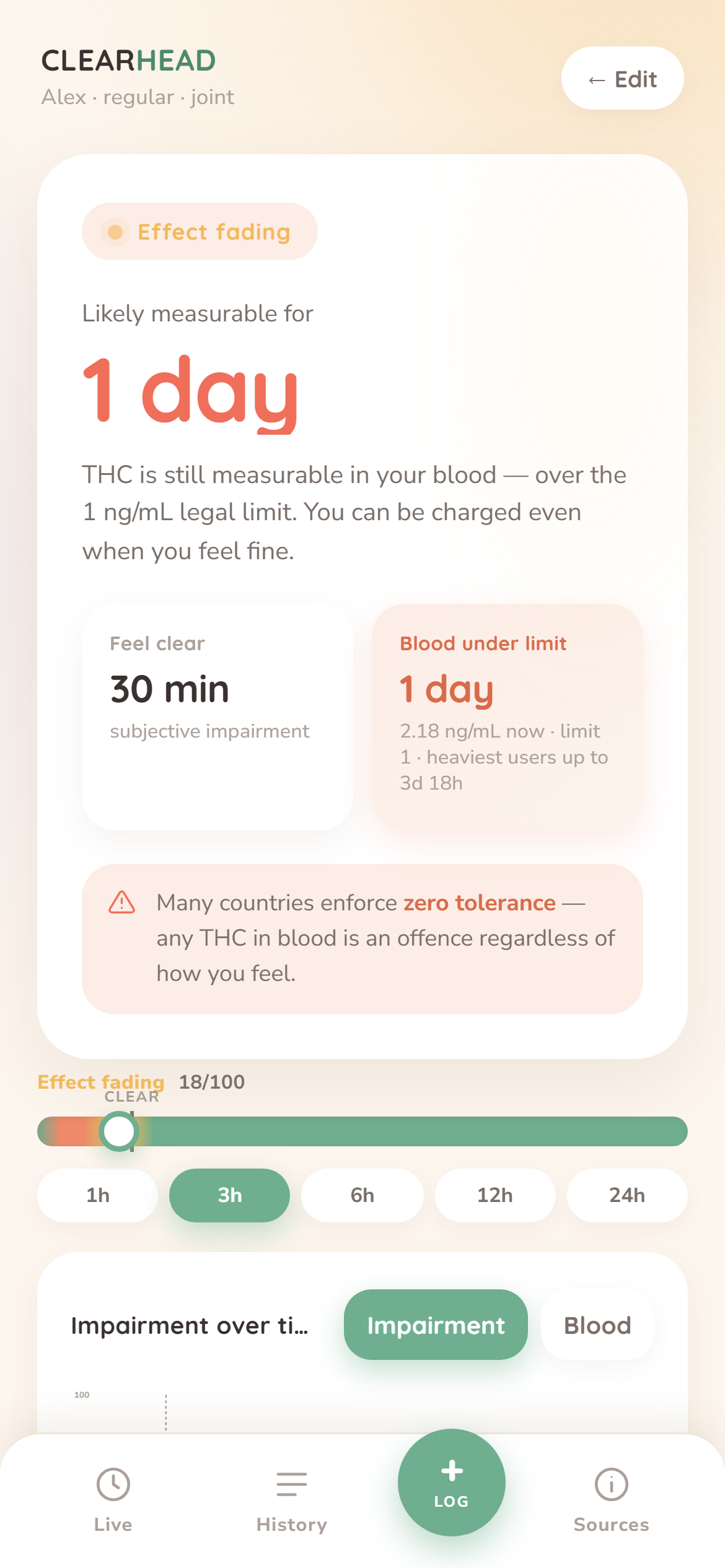
The table gives you the number. Clearhead estimates the time.
Enter what you took and when. The app applies the same published pharmacokinetic model to your pattern, dose and body, and shows an estimated blood level against the legal limit, plus saliva and urine windows — as a live countdown. Private, offline, no account.
Get the appAn estimate, not a measurement · Not permission to drive · The safest choice is always none.
Frequently asked
What is the THC driving limit in Germany?
3.5 ng/mL THC in blood serum (§ 24a StVG), in force since 22 August 2024. Reaching it is an administrative offence (standard: €500, one-month ban, two points). With actual impairment, a criminal charge under § 316 / § 315c StGB can apply at any concentration. No German law of 2026 changed this figure.
Which European countries have a numeric THC limit?
Eleven jurisdictions: Germany 3.5 ng/mL serum; Czech Republic 2 ng/mL serum; Luxembourg 1 ng/mL serum; Belgium 1 ng/mL plasma (10 ng/mL saliva lab, 25 ng/mL roadside device); Switzerland 1.5 µg/L whole blood; Netherlands 3.0 µg/L (1.0 combined) blood; Ireland 1 ng/mL whole blood; Denmark 0.001 mg/kg blood; Norway 0.004 / 0.010 / 0.030 µmol/L whole blood (graded); the United Kingdom (England, Wales, Scotland) 2 µg/L whole blood; Malta 2 µg/L whole blood since 10 March 2026.
Which countries have zero tolerance for THC when driving?
France, Spain, Sweden, Finland, Slovakia, Slovenia, Croatia, Bulgaria and Cyprus — any detected use or presence is the offence, with no threshold. Finland requires the active substance (the inactive metabolite THC-COOH alone is not enough, KKO:2016:42); Slovenia counts blood or saliva but not urine; Cyprus tests saliva "regardless of the quantity".
Which countries have no THC number at all?
Austria, Poland, Italy, Hungary, Romania, Portugal, Latvia, Lithuania, Greece and Northern Ireland. In each, a physician, forensic expert or court decides whether the driver was impaired — the law names no concentration. Estonia could not be verified.
Why are THC limits not comparable between countries?
Because the measurement medium differs: blood serum or plasma reads about twice as high as whole blood for the same sample, so 3.5 ng/mL serum and 1.5 µg/L whole blood are closer than they look. And even under a per-se limit, a separate criminal impairment charge can apply at any level — being under the number is not the same as being in the clear.
Does Poland have a 2.5 ng/mL THC limit?
No. Polish law names no concentration. The 1 and 2.5 ng/mL figures are a 2012 forensic consensus applied through expert opinion; Parliament explicitly rejected codifying them in 2014. Whether a case is a crime (art. 178a) or a misdemeanour (art. 87) is decided case by case.
Is 50 ng/mL the THC limit in Portugal?
No. Portugal has no THC driving limit — "influence" is a medical or expert finding, confirmed by the Supreme Court in 2024. The 50 ng/mL figure is a urine screening cut-off from the regulation's annex, not a blood value and not a driving limit.
What changed in 2025–2026?
France (20 August 2026): a new offence for "manifest" drug use with no analysis required, and licence retention on suspicion — still no number. Malta (10 March 2026): a brand-new per-se regime at 2 µg/L. Italy (July 2026): the Court of Cassation confirmed that mere positivity is not enough. Romania (January 2025): no longer zero tolerance — presence plus capacity to impair. Belgium (May 2026): ketamine added, THC unchanged. Bulgaria: a 1 ng/mL threshold is in draft only — not law.
How long after use does THC stay above these numbers?
Population estimates from published studies: after a single joint, plasma THC typically falls to around 1–2 ng/mL within 3–6 hours and well under 1 ng/mL by 12 hours (halve for whole blood). Daily or heavy users carry a baseline of roughly 1–3 ng/mL plasma that halves only every 3–5 days after stopping; half of heavy users were still above 1 ng/mL a week in. These are estimates, not measurements, and never permission to drive.
Is there an EU-wide THC driving limit?
No. Drug-driving law is national. Eleven European jurisdictions set a THC concentration, nine run zero tolerance, ten have no number and rely on an assessment of impairment. The figure that applies is the one in the country you are driving in — your home country’s rule does not travel with you.
Which is stricter — 3.5 ng/mL serum or 1.5 µg/L whole blood?
They are closer than they look. Serum and plasma concentrations run roughly twice those in whole blood for the same sample, so Germany’s 3.5 ng/mL serum corresponds to about 1.7 ng/mL whole blood — only slightly above Switzerland’s 1.5 µg/L. Belgium’s 1 ng/mL plasma is stricter than either.
Help us keep this accurate
Legal limits change and enforcement varies. If you have legally-backed information for your country — the exact threshold, a link to the legislation, or official material — please send it to us. We'll review and update the table (with credit if you like).
Email us verified info →